
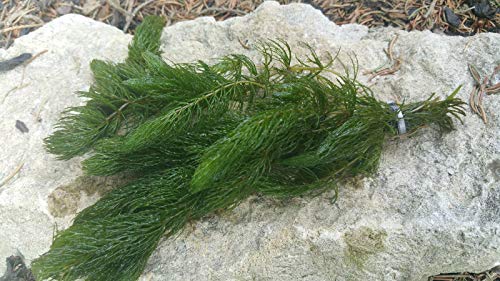
Ceratophyllum demersum ‘Hornwort’
Price range: £7.25 through £55.99
Hornwort (Ceratophyllum demersum) is a powerful UK oxygenating plant that naturally reduces pond algae, controls blanketweed and boosts oxygen levels. Ideal for keeping fish ponds and wildlife ponds clear, clean and healthy with minimal maintenance.
Ceratophyllum demersum (Hornwort)
The Leading Oxygenating Plant for Natural Pond Algae Control
Hornwort (Ceratophyllum demersum) is one of the most effective native oxygenating plants for keeping pond water clear, balanced, and resistant to algae blooms. Its dense, free‑floating foliage absorbs excess nutrients — the same nutrients algae rely on — making it a powerful natural tool for reducing blanketweed, green water, and seasonal algae spikes.
This hardy UK native thrives in all pond depths, from wildlife ponds to deep ornamental features. Because it doesn’t root, it can oxygenate water at multiple levels, improving circulation and supporting fish health. In winter it naturally darkens as it enters dormancy, returning to strong green growth in spring.
Key Features
- Exceptional Algae Control – Competes with algae for nutrients, helping prevent blanketweed and green water.
- High Oxygen Output – Supports fish health and boosts biological filtration.
- Free‑Floating, No Soil Needed – Simply drop it in or weight it down.
- Native UK Oxygenator – Wildlife‑friendly and perfectly adapted to British ponds.
- Medium Growth Rate – Easy to manage and thin out when needed.
- Attractive Foliage – Fine, horn‑like leaves provide shelter for fry and aquatic life.
- Light Requirements – Full sun to part shade
- Depth Range – 30–200 cm
Recommended Quantities for Algae Control
For effective nutrient uptake and algae suppression:
| Pond Size | Recommended Amount |
|---|---|
| Small Pond (up to 1,000 L / 1m²) | 3–4 bunches |
| Medium Pond (1,000–5,000 L / 1–5m²) | 6–12 bunches |
| Large Pond (5,000–20,000 L / 5–20m²) | 12–25+ bunches |
For ponds with persistent algae issues, use the higher end of the range.
Planting & Care
- Weight down with lead strips or ceramic weights, or allow to float freely.
- Thin out excess growth during summer to maintain balance.
- Winter die‑back is normal — Hornwort rebounds strongly in spring.
- Works best when combined with marginal plants and lilies to shade the water surface.
How Hornwort Compares to Other Oxygenators for Algae Control
A comparison based on nutrient uptake, growth behaviour, and suitability for algae‑prone ponds:
| Oxygenator | Algae Control Strength | Growth Style | Best For | Notes |
|---|---|---|---|---|
| Hornwort | Excellent | Free‑floating | Deep ponds, fish ponds | Strong nutrient uptake at depth; great for green water control |
| Elodea canadensis | Very Good | Rooted or floating | Wildlife ponds | Fast‑growing; can outcompete algae quickly |
| Elodea crispa | Very Good | Rooted | Ornamental ponds | Attractive structure; reliable algae competitor |
| Callitriche stagnalis (Starwort) | Good | Rooted | Shallow ponds | Great for surface cover; softer growth |
| Hottonia palustris (Water Violet) | Moderate | Rooted | Clear, low‑nutrient ponds | More decorative; not a primary algae‑control plant |
Why Hornwort stands out for algae control:
- Competes aggressively for nutrients
- Oxygenates deeper water where algae often thrive
- Doesn’t root, so it spreads oxygenation throughout the pond
- Less invasive than Elodea canadensis but still highly effective
- Best pond plants for algae control UK
- Natural algae prevention for garden ponds
- Oxygenating plants to reduce blanketweed
- Hornwort for green water reduction
- Ceratophyllum demersum algae control
- Pond plants that outcompete algae
- Native UK oxygenators for algae‑prone ponds
- Improve pond clarity naturally
- Deep‑water oxygenating plants for algae suppression
- Low‑maintenance pond plants for algae‑free water
Why Buy from Artisan Aquatics?
- Specialist supplier of healthy, UK‑grown oxygenators
- Fast delivery and expert advice
- Trusted by pond keepers, landscapers, and wildlife enthusiasts
- Plants selected fresh for maximum performance
| PLANT TYPE | Oxygenating b |
|---|---|
| FLOWER COLOUR | Brown |
| SUN/SHADE | Full sun to part shade |
| NATIVE | Native |
| SEASON | Spring, Summer |
| HEIGHT MIN | 0 |
| HEIGHT MAX | 0 |
| DEPTH MIN | 30 |
| DEPTH MAX | 200 |
| SPREAD MIN | 0 |
| SPREAD MAX | 0 |
| FLOWER TIME | May to Jul |
| POT SIZE | Pack of 10, Pack of 20, Pack of 3, Pack of 30, Pack of 5 |