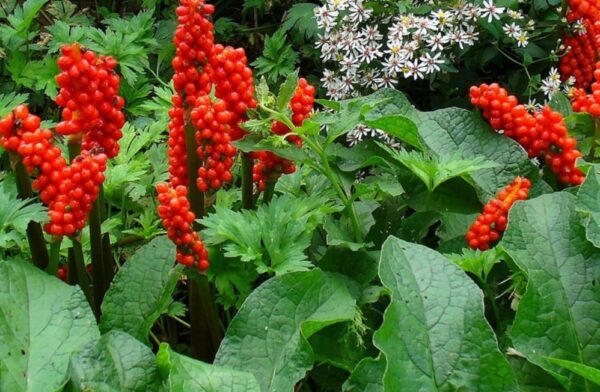
Arum italicum – Hardy Winter Foliage Plant for Shaded Marginal Areas
Arum italicum is a striking hardy perennial valued for its glossy winter foliage, elegant spring flowers, and vibrant summer seed spikes. Ideal for shaded pond margins, woodland edges, and damp garden areas, it provides year‑round interest and thrives in moist, humus‑rich soil. Its ability to emerge when most plants are dormant makes it a standout structural plant for winter displays.
Key Features
- Winter‑Emerging Foliage — bold, marbled leaves appear in late autumn and persist through winter.
- Spring Flowers — subtle creamy spathes add seasonal interest.
- Summer Seed Spikes — bright orange‑red berries provide a dramatic focal point.
- Shade‑Loving — thrives in partial to full shade, perfect for pond edges and woodland gardens.
- Moisture‑Tolerant — performs well in damp, humus‑rich soils.
- Low Maintenance — long‑lived, reliable, and easy to grow.
Technical Specifications
- Botanical Name: Arum italicum
- Type: Hardy perennial
- Position: Partial shade to full shade
- Soil: Moist, fertile, humus‑rich
- Height: 30–45 cm
- Spread: 30–40 cm
- Flowering: Spring
- Foliage Season: Autumn–Spring
How Arum italicum Performs
Winter Interest
Provides lush foliage when most plants have died back, making it invaluable for structural winter planting.
Marginal & Shaded Areas
Thrives in low‑light conditions, ideal for pond edges, under shrubs, or shaded borders.
Seasonal Layering
Dies back in summer, allowing other shade plants to take over — perfect for layered planting schemes.
Ideal For
- Shaded pond margins
- Woodland gardens
- Damp, humus‑rich soils
- Winter interest planting
- Underplanting around shrubs and trees
- Naturalistic and wildlife‑friendly gardens
Planting & Care Notes
- Plant in moist, fertile soil with good organic matter.
- Ideal for shaded or semi‑shaded locations.
- Allow foliage to die back naturally in summer.
- Avoid planting where pets may disturb berries.
FAQ
Q: Does Arum italicum stay evergreen? A: It is winter‑green — foliage appears in autumn and lasts until late spring.
Q: Is it suitable for pond margins? A: Yes, it thrives in damp, shaded marginal areas.
Q: Does it spread? A: It naturalises slowly, forming attractive clumps over time.
Q: Are the berries harmful? A: The berries can be toxic if eaten, so avoid planting where pets may chew plants.